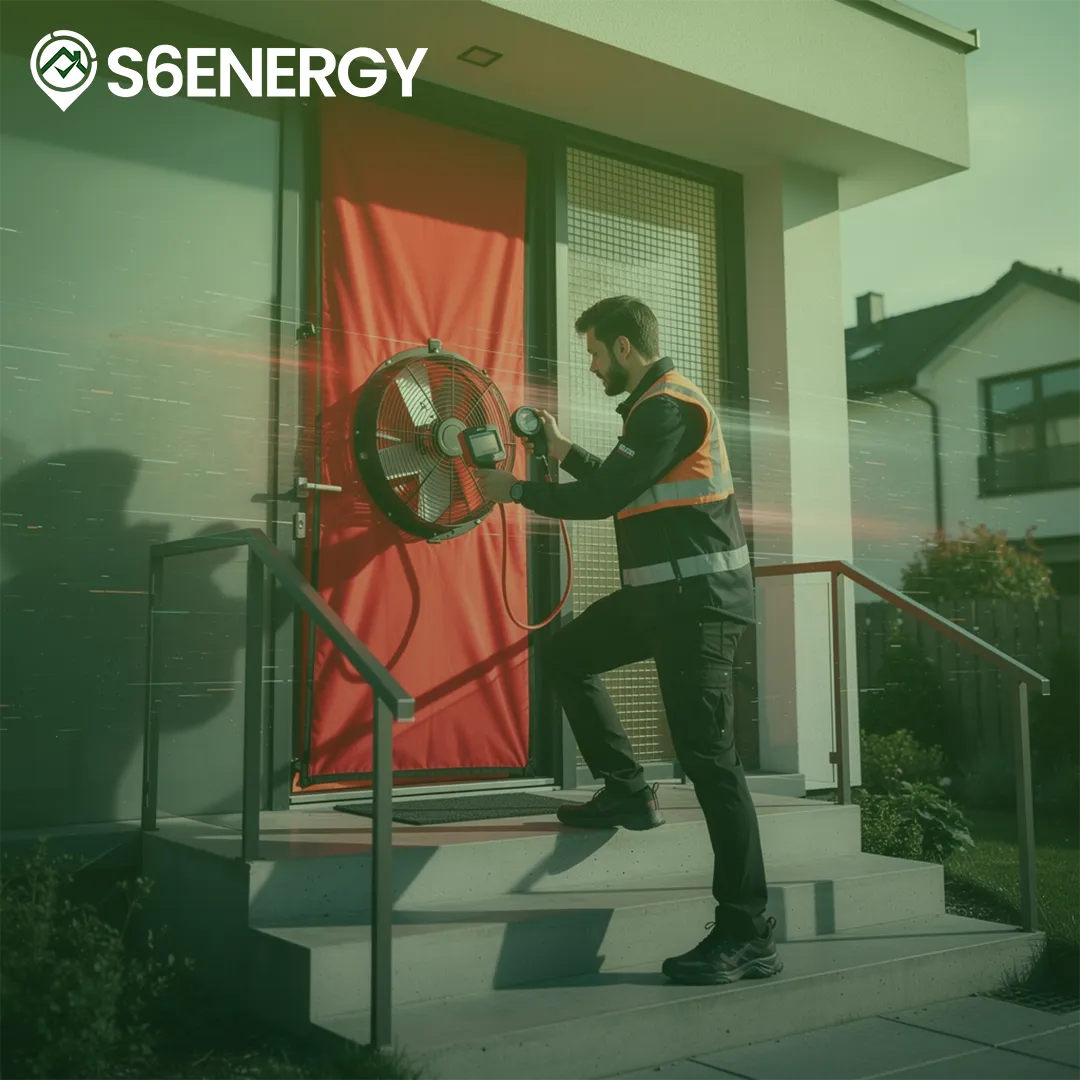
Only one chance is available to combine your building envelope correctly. If you construct a building once with timber or any plaster, then it’s difficult to improve it. And here, blower door testing helps you to play an important role. This test ultimately checks air leakage and heat loss. This method is an approved method for evaluating your building envelope and air tightness.
Professional conduct this test for helping home with multiple air and heat loss solutions. Learn how it works and how it performs well to make your home energy efficient. Details are under the line.
Book a professional Retrofit Assessment with S6Energy today to identify air leaks, improve airtightness, and boost your home’s energy efficiency.
What is a blower door test, and how does the test work?
Blower door test checks the airleakage and tightness. The leakages can be because of cracks in building envelopes, which also affects day comfort and environment,t including energy efficiency and different health problems. With your door testing and equipment, it is very easy to measure air tightness in buildings, dwelling and rooms.
This test is conducted for energy assessment contractors who have been operating it to use this method to check the holes and draughts, as well as for leakage.
Most temporary mounts work as a frame for the exterior doorway. A fan with excessive power is installed in the outer door to maintain air pressure inside. And all the air pressure flows out from the unsealed gaps and cracks or wiring penetrations. If the air pressure cannot be lowered, the fan can work in reverse to increase the air pressure.
When blower tests are being enterprises the experts fitted some cameras to analyse wall and roofs to determine the areas where insulation and air leakage are happening.
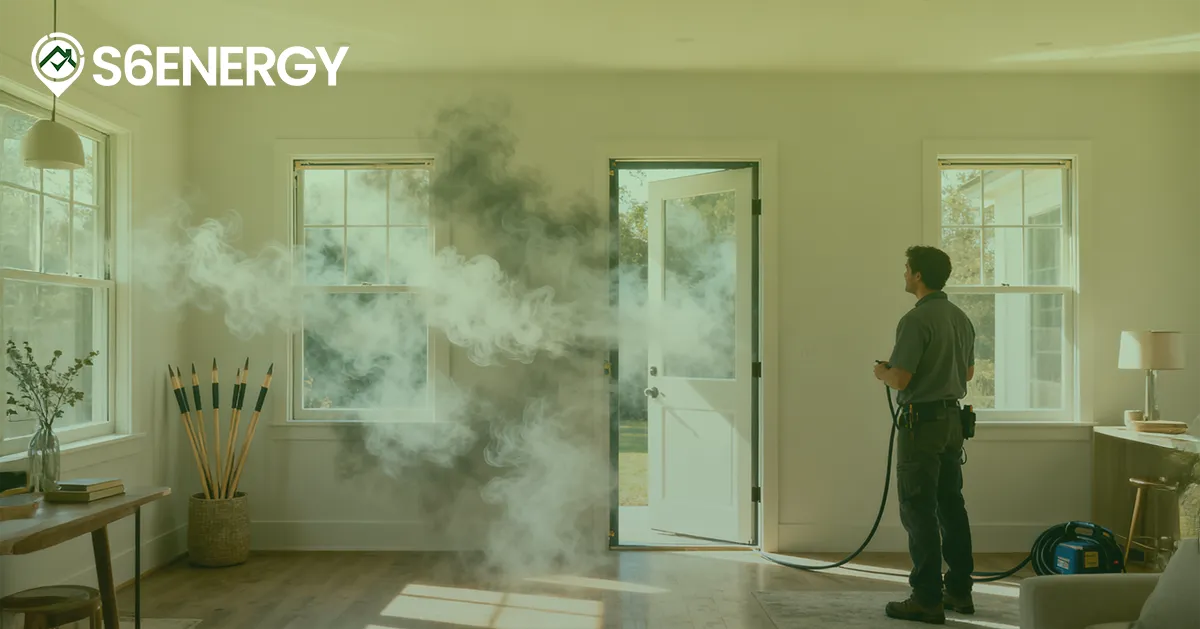
What is a blower door test
Types of blower door test
Calibrated and uncalibrated are the types of blower doors
Calibrated blower doors
These are the most important. After all, auditors preferred this one because these have gauges to measure the amount of air flow out of the home with blower fans.
Uncalibrated blower doors
They are not preferable because of their uncertainty about the air tightness of the home. There is no method to provide any liquid achievement for Air sealing.
Preparation for blower door test
The energy professionals can perform this test, which is included with the settings of the blower door. Here are some steps which are required for the preparation of the home for the blower door testing.
- Try to be with the auditor while checking the home, and be ready to address the areas which are having gaps.
- Provide the excess of all areas to the auditors, including closets and cabinets, attics and storage spaces, to assess keenly for better leakage improvement.
- Let the auditors open up all interior doors and close all outer doors and dampers, doors, and Woodstoves Intel’s windows as well.
- Make sure to clean the firewood that you are used to heating your home with
- Let the auditor set up safety controls in the furnace, water heater, and fireplaces, including stoves. This can control the atmospheric fossil fuel.
- This test can take more than an hour because it completely depends on how complex your home’s condition is.
What blower door test equipment is needed to undertake the test in the UK?
The components which are used to undertake the test are:
- Digital manometer
- Aluminium panel frame
- door cloth
- thermometer
- Barometer
- high-powered fan with the range ring ABC and L flow plates.
What are the blower door test targets?
For different commercial buildings and dwellings. These test rates may vary; however, the buildings using MVHR have to fulfil the target of 3m3/h.m2.However, this is helpful for the homes and trader buildings. But in the UK, the most common target to achieve is 5m3/h.m2.And this is considered difficult to get.
If test failure underlines, then the cameras are helpful to locate the actual air leakage area and detect the smoke leakage parts which cause air movement and temperature differences.
Reasons for the blower door test
Different purposes can be concerned to perform blower door testing.
- Checking building compliance and standards, which required different levels of air tightness for new buildings.
- Moreover, ISO standards are used to assess building airtightness and air quality in controlled environments, such as clean rooms and energy-efficient buildings.
- Address air leakage problems which cause energy consumption and high bills, poor air quality, and moisture problems.
- You can evaluate the effect of air sealing measures, which improves air tightness of rooms and other buildings.
- With this test, you can determine the proper air flow requirements which need heating and cooling equipment to make your home comfortable.
- Also, check the mechanical ventilation requirements for fresh air and maintenance of air quality.
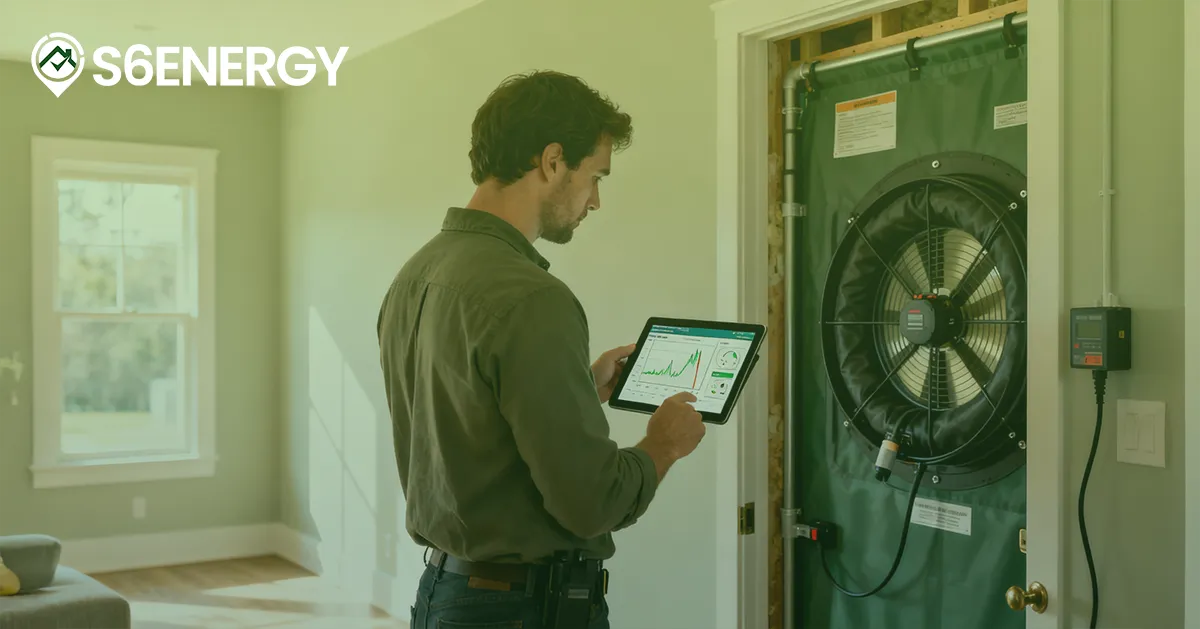
Blower door test assessment
What if buildings fail the blower door test?
If any building fails this test, then you don’t need to be worried. A combined lower door smoke testing is an alternate way that works on thermal air leakage service to help to improve air leakages through building fabric. Moreover, the clients can undertake the repairs in a day to achieve the targets of the air tightness test.
Must provide the report of failure to the contractors to achieve their targets back and address the actual air leakage parts to make building envelopes better and pass the test.
Advantages of the blower door test
- It works to establish the home environment by using different methods and proven track records as well.
- It provides comprehensive data about building air tightness and the pressure range.
- This test identifies the points which cause air leaks and require repairs
- It follows a non-destructive process that does not damage the building fabric during testing.
- A complete setup of equipment that is used for conductivity tests can take a longer time than pulse testing, and it might take more than 2 hours and vary by complexity.
Comparison between pulse testing and door testing
Furthermore, both of these are conducted by different methods and approaches. The purpose is to achieve the air-tightness targets.
Pulse testing
- 4Pa pressure range, which is considered lower
- Disruption is minimal
- Testing time is faster
- It’s providing data at lower pressure
- Limited to check the area that leaks
Blower door testing
- The pressure is high, around 50 Pa
- Considered disruptive
- Take a long time to test
- Comprehensive data and pressure range
- It can easily identify locations of air leakage to improve them soon.
Conclusion
Finally, we can say, the blower door test is a tool to diagnose air tightness in the building and helps to improve it. Furthermore, it controls the pressure across the envelope. This test identifies the air leakage in the air sealing while using strategies to enhance energy efficiency, reduce heat, and boost the comfortable environment.
In addition, it verifies the compliance and design according to the building and its codes.
It provides improvement results to prevent moisture and air quality issues inside, with condensation problems. This test must be required for the new construction homes and buildings. It adds valuable insights to lead performance for the long term and is also effective for cost savings and a healthier environment.
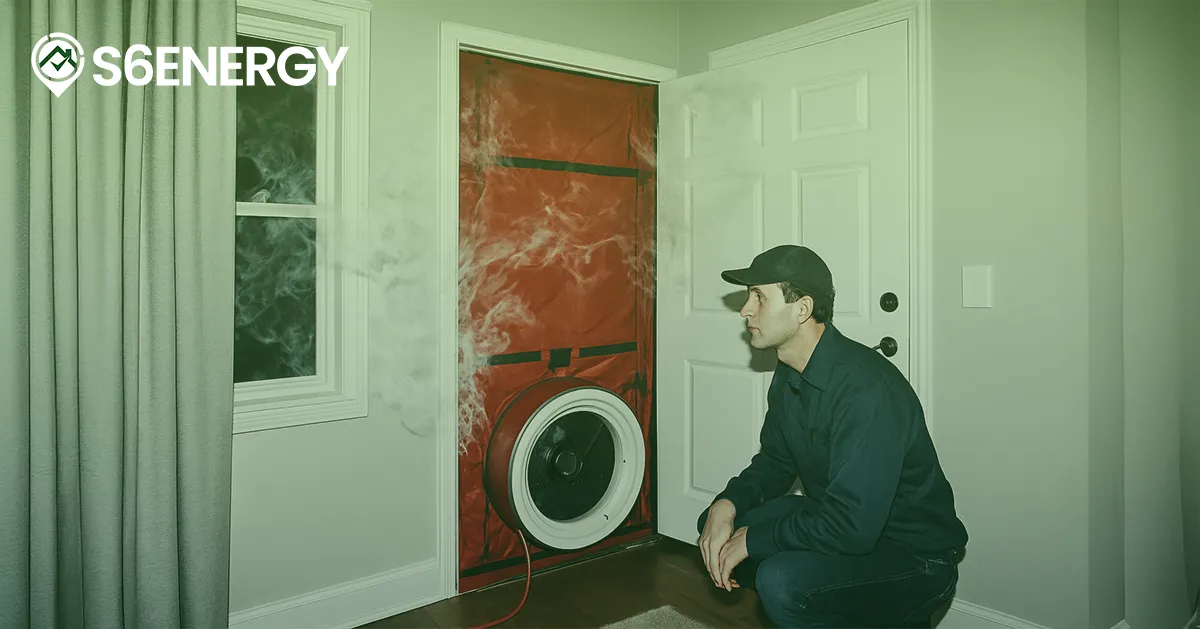
Blower door test to diagnose air tightness
Read More: Trickle Vents
FAQs
When is it compulsory to conduct a blower door test?
It is compulsory for new construction and renovation buildings, also known as energy audits. With this test, constructors can easily complete the fixing of air leakages.
How does the blower door testing work?
It is a kind of fan which helps to depressurise the building and control the air pressure inside through gaps and cracks. Moreover, the airflow is measured to maintain the pressure level and measure the air leakage rate.
How do the blower door testing results show?
It appears in the results, which show the air leakage ratings from the building, but also the air changes per hour happens and it can affect air values.
What is blower door testing?
This is a procedure which diagnoses and measures the building airtightness. An extreme powered fan is installed at an external doorway to control the air pressure and identify leakages in the building envelope.
How long does a blower door test take?
This test can take hours, but also varies by the area which required improvement and has leakages. If your home is small, then 30-60 minutes is enough for it. Some important requirements for his test are building preparation size and the number of places that are diagnosed with leakages.
How much does a blower door test cost?
It is independent of the size and complexity. And those are roughly ideas which can be estimated as for the standard and typically home 160£ to 500£. Average cost can be £350 to 400£.
Detail reporting and thermal imaging can cost £350 to £450. Big buildings can be more than 800£.